
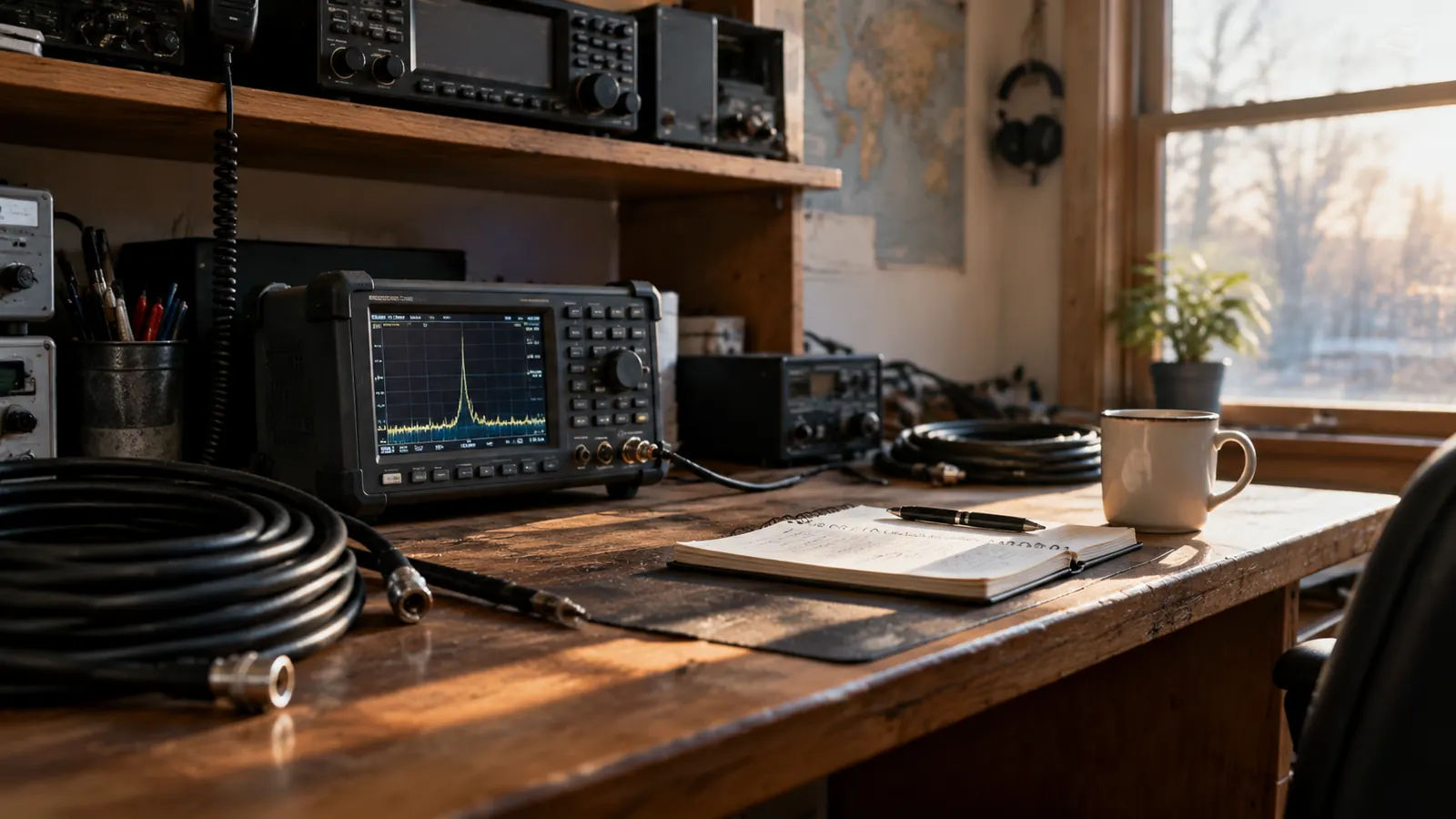
If you spend any time around ham radio, you will eventually hear somebody say you need an antenna analyzer, and then you will look up the price of a good one and decide your SWR meter is fine. I thought the same thing for years. I have been a ham since 2009, upgraded to General in 2012, and for most of that time a basic SWR meter was the only test equipment I owned. Then the ice storm of 2020 knocked out power and cell service in my county for four days, and I got serious about making sure my radios actually worked when I needed them. That is when I bought the AURSINC NanoVNA-H, about two years ago, when I rebuilt my setup after my old handheld finally died. It changed how I work on antennas. But it did not make my traditional SWR meter useless. The honest answer to which one is worth buying is: it depends on what you are trying to do.
Here is the short version. SWR, or standing wave ratio, is a measure of how much of your radio's power actually reaches the antenna instead of bouncing back down the coax. A traditional SWR meter gives you that one number at one frequency. The AURSINC NanoVNA-H gives you a whole curve across the band, plus return loss and impedance, and it does it without you keying up the transmitter. If you want to tune an antenna, find out why a repeater is hard to hit, or check whether a coax run is the problem, the NanoVNA-H does in a few minutes what a traditional SWR meter cannot do at all. If you want a quick pass-fail check before you key up, a traditional SWR meter is faster, cheaper, and plenty good. I keep both on the bench, but the NanoVNA-H is the one I reach for first.
| AURSINC NanoVNA-H | Traditional SWR Meter | |
|---|---|---|
| Price | Costs more than a basic meter, still far less than a lab-grade analyzer | Cheap to very cheap, most hams already own one |
| What it measures | SWR, return loss, impedance, and a full frequency sweep in one pass | SWR at one frequency at a time, sometimes forward and reflected power |
| Ease of use | Needs a short learning curve, menus and calibration are real work | Plug in, key up, read the needle or the digits |
| Finding problems | Shows you the whole picture across a band in one sweep | Tells you the number but not where the problem is |
| Power needed | Runs on a battery, no transmitter required | Needs the radio to key up while you read it |
| Best for | Tuning antennas, chasing feedline problems, learning how your system behaves | A quick check that an antenna is safe to use |
Where the AURSINC NanoVNA-H Wins
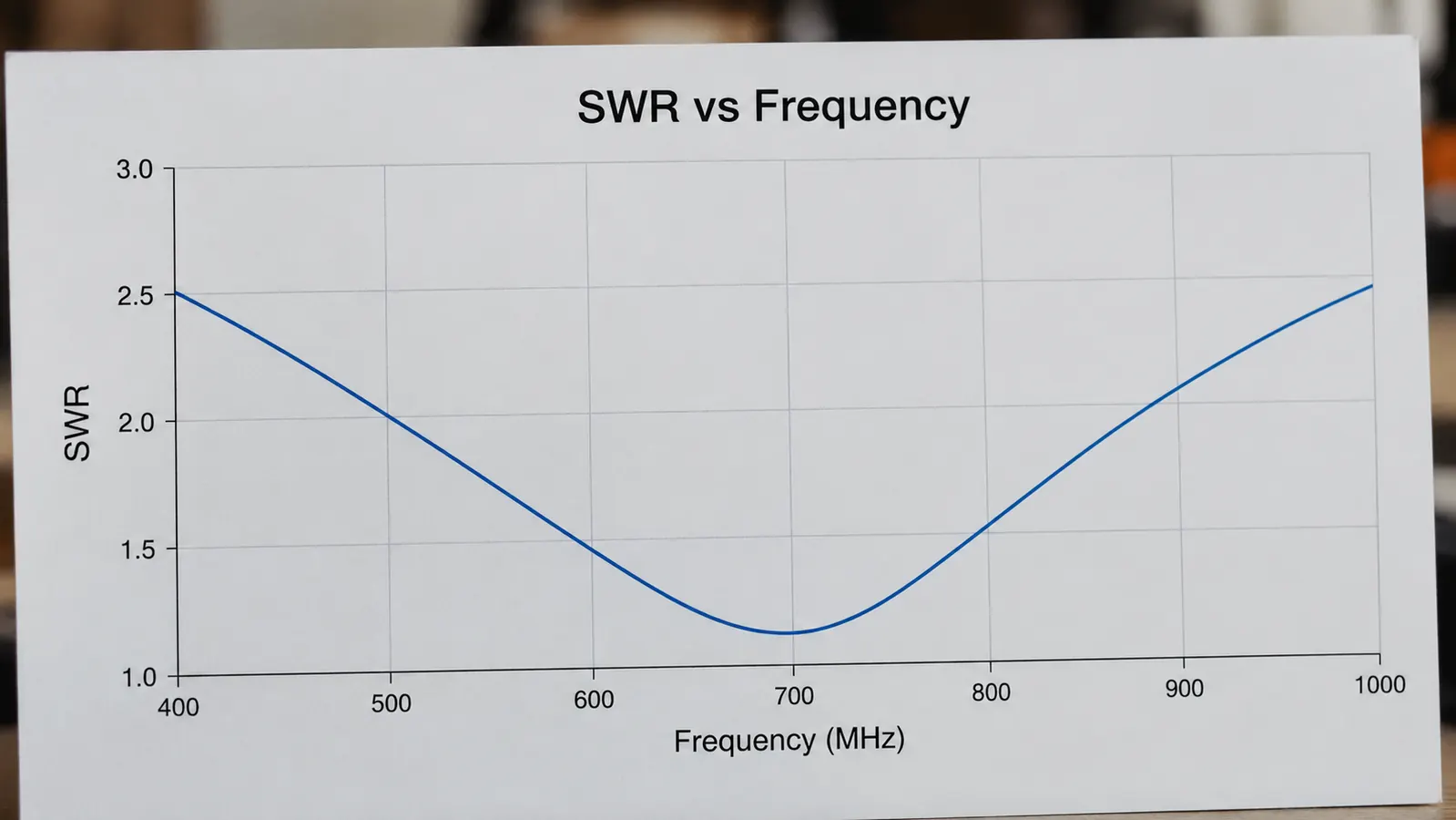
The big win is the sweep. With a traditional SWR meter, I check one frequency, write down the number, change the frequency, check again, and repeat. On a good day that takes a while and I still only see a handful of points. With the NanoVNA-H I set the start and stop frequencies, let it run, and get a curve showing SWR across the whole band. The dip in the curve is where the antenna is resonant. If the dip sits in the middle of the band, the antenna is tuned where I actually operate. If it is off to one side, I know which way to adjust the length. On the wire antenna in the backyard, that means I can trim the end or move the feed point and watch the dip move on the screen. No guessing, no keying up a dozen times.
That is also how I found out the VFAN dual-band magnetic-mount antenna on my F-150 was not as good as I thought. On paper it should cover the 2-meter band fine. The sweep showed the resonant dip sitting low, near the bottom edge of the band, which explained why a repeater I used to hit easily had started sounding weak. A repeater, in case you are newer to this, is an automated station that receives your signal and retransmits it, which is how a mobile rig reaches across town. A few minutes with the NanoVNA-H and a small adjustment to the antenna placement on the cab roof moved the dip back where it belonged. A traditional SWR meter would have told me the SWR was a little high on one repeater frequency, but it would not have shown me the whole curve or pointed me to the fix.
The other thing the NanoVNA-H does that a meter cannot is measure the feedline itself. When I ran a new length of coax for the house antenna, I swept it before I connected anything. The trace looked clean, which told me the cable and the connectors were good before I climbed up and put the antenna in the air. With a traditional meter, a bad connector can look like a bad antenna, and you end up chasing the wrong problem. The analyzer separates the two.
Where a Traditional SWR Meter Wins
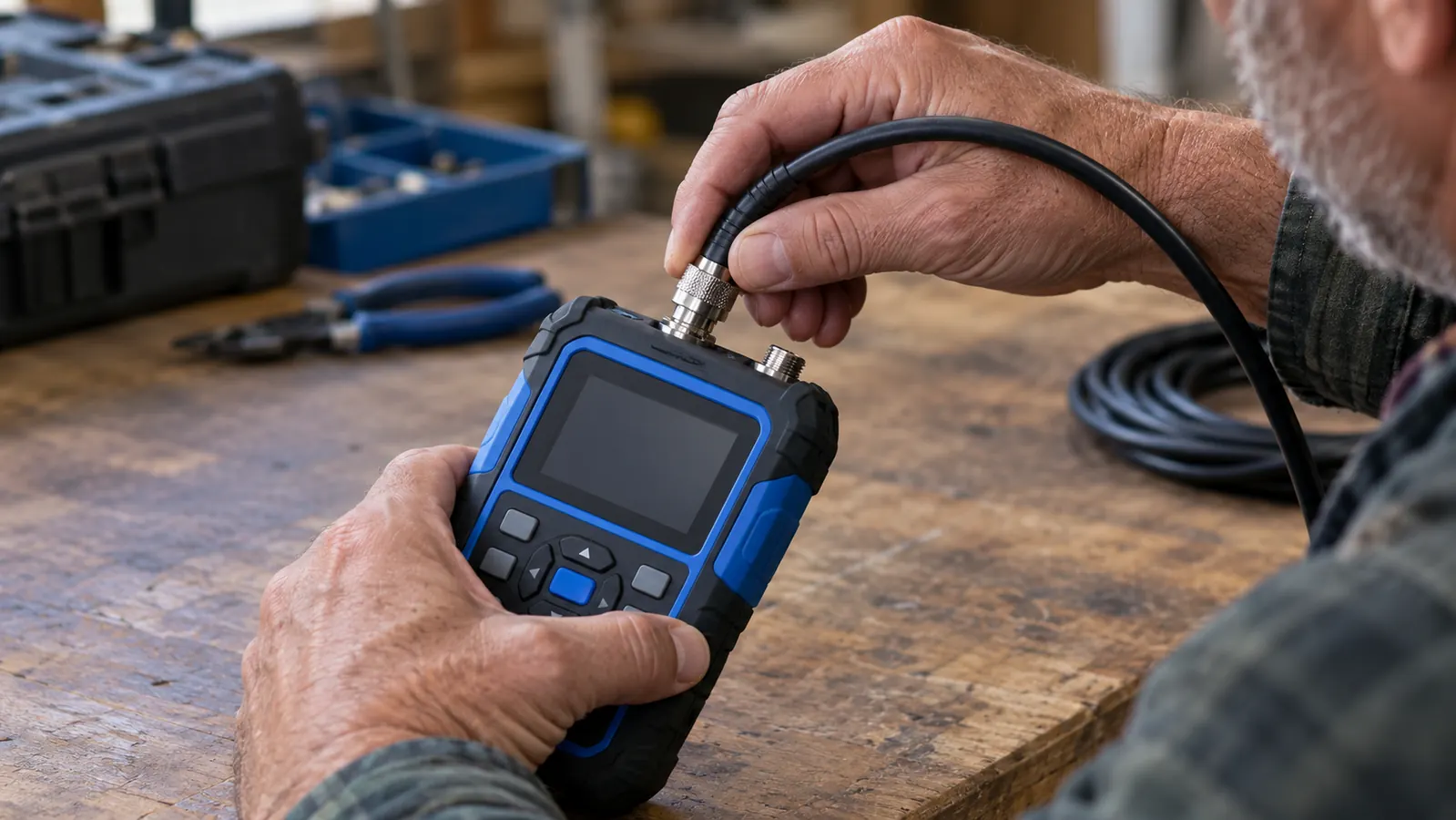
I am not going to pretend the traditional meter is obsolete, because it is not. It wins on simplicity. There is no menu, no calibration routine, no learning curve. You connect it between the radio and the antenna, key up, and read the number. When I am in the truck and I just swapped in a spare antenna, that is the tool I want. It takes less than a minute and tells me what I need to know: is this antenna safe to transmit on, yes or no. The NanoVNA-H can answer that too, but it asks more of you to get there.
It also wins on price and on durability. A basic SWR meter is inexpensive, and if it gets knocked around in a door pocket or a toolbox, you are not out much. The NanoVNA-H is a more delicate instrument with a screen and a battery and a calibration step that matters. I treat it like a piece of test equipment, because that is what it is. The traditional meter lives in the truck and takes whatever the truck dishes out. There is also something to be said for a meter that runs on nothing but the signal you feed it. No battery to charge, no firmware to update, no menu to get lost in at the side of the road.
There is one more thing the traditional meter does that I appreciate, and it is the reason I have not retired mine. It shows forward and reflected power, which tells you not just that the antenna is mismatched but how much power is actually going out. On a low-power rig, every watt counts, and knowing that the meter reads 5 watts forward and a sliver reflected is reassuring in a way a sweep is not. The NanoVNA-H cares about the antenna, not the radio. The meter cares about the whole system. They answer different questions.
See the whole band in one sweep instead of guessing from one number
The AURSINC NanoVNA-H shows you SWR, return loss, and impedance across the entire band, so you can find and fix antenna problems instead of just confirming they exist.
Amazon Check Today's Price on Amazon →What the Numbers Actually Mean
Return loss is just another way of expressing SWR, and impedance is the resistance the antenna presents to the radio at a given frequency. You do not need to master all three to use the NanoVNA-H. The trace on the screen shows you the shape of the problem, and the shape is usually enough. A sharp, deep dip means a well-tuned antenna. A wide, shallow dip means the antenna is working but not resonant where you want it. A trace with multiple bumps usually means something is wrong with the feedline or the connectors.
The calibration step is worth learning. Before I sweep anything, I do the open, short, and load calibration that the manual describes. It takes about two minutes and it keeps the measurements honest. Skip it and the trace can be off by enough to send you chasing a problem that is not there. That is the kind of detail a traditional meter never asks you to think about, which is exactly why the meter is easier to grab for a quick check.
One warning before you buy: the NanoVNA-H is not a power meter. It does not measure how many watts your radio is putting out, and it will not tell you if your finals are weak. It is a measurement tool for antennas and feedlines, not a full bench test set. If you want forward and reflected power readings, you still need a traditional meter or a proper wattmeter. That is not a flaw in the NanoVNA-H. It is just a reminder that no single tool does everything.
How I Compared Them
I put both tools on the bench with the same antenna and the same coax. The traditional meter gave me a single SWR reading at 146.520, the national calling frequency for 2 meters. The NanoVNA-H swept the whole band and showed me the same antenna's behavior from 144 to 148 megahertz. The single number was not wrong. It was just one slice of the picture. The sweep showed me that the antenna was resonant a little below where I do most of my talking, which explained a lot about why some repeaters sounded better than others.
I also tested the NanoVNA-H on a known bad cable, a length of coax with a crushed connector, to see if the trace would catch it. It did. The bump in the trace was obvious. The traditional meter on the same cable just showed a higher SWR, which could have meant a bad antenna, a bad cable, or a bad connection. That is the real difference between the two tools. One tells you the system has a problem. The other tells you where to look.
Who Should Buy Which
Buy the AURSINC NanoVNA-H if you tune your own antennas, if you have a repeater you cannot quite hit and you want to know why, or if you are the kind of ham who likes to see the actual curve instead of a single number. It pays for itself the first time it finds a problem a meter cannot show you. I use mine on the backyard wire antenna for the house radio and on the truck antenna, and I would not go back to tuning by guesswork. If you are just getting started in the hobby, it is also a fine learning tool, because it shows you how an antenna actually behaves across the band instead of giving you one number with no context.
Stick with a traditional SWR meter if you mostly operate on one or two frequencies, if you just want a quick safety check before you key up, or if you do not want to learn another piece of test equipment. The NanoVNA-H is not hard to use, but it does ask you to learn a few things first. For a lot of hams, that is a reasonable trade. For some, it is not worth it. There is no shame in keeping the simple tool if the simple tool covers your needs. My own bench has room for both, and both earn their spot.
One more thought on the learning curve. The NanoVNA-H has a small screen and menus that take some getting used to, and the first few sweeps will feel clumsy. Give it an afternoon. Once the controls make sense, it becomes the fastest antenna tool you own. I have taught myself to do a full sweep in the time it used to take me to set up the meter and make one measurement. That is the trade in a nutshell: a little learning up front, a lot of time saved later.
The Bottom Line
Here is the honest bottom line after two years with both tools on my bench. The AURSINC NanoVNA-H replaced most of what I used a traditional SWR meter for, but not all of it. The meter still has a job in the truck and in my go bag. If I could only keep one, I would keep the NanoVNA-H, because it finds problems the meter cannot see. But I would not tell a new ham to throw away a perfectly good SWR meter to buy one. Start with what you have, learn what the numbers mean, and upgrade when you hit a question the meter cannot answer.
For me, that question came after the ice storm in 2020 taught me how much I rely on the radio when the power and the phones go down. I wanted to know my antennas were as good as I could make them, and the NanoVNA-H is the tool that lets me check. If you are in the same place, wondering whether your antenna is really working, that is the sign that the analyzer is worth the money.
Whatever you decide, the important thing is that you check your antenna before you transmit. A high SWR can damage a solid-state radio, and a badly tuned antenna wastes your power and your time on the air. The tool you use to check it matters less than the habit of checking. The AURSINC NanoVNA-H makes the habit easy, which is why it earns its place on my bench. But the ham who checks every antenna with a basic meter is ahead of the ham who never checks at all.
If you tune antennas, this is the tool you will reach for every time
The AURSINC NanoVNA-H replaces guesswork with a full-band picture. Two years in, it is the first thing I grab when an antenna is not behaving.
Amazon Check Today's Price on Amazon →