
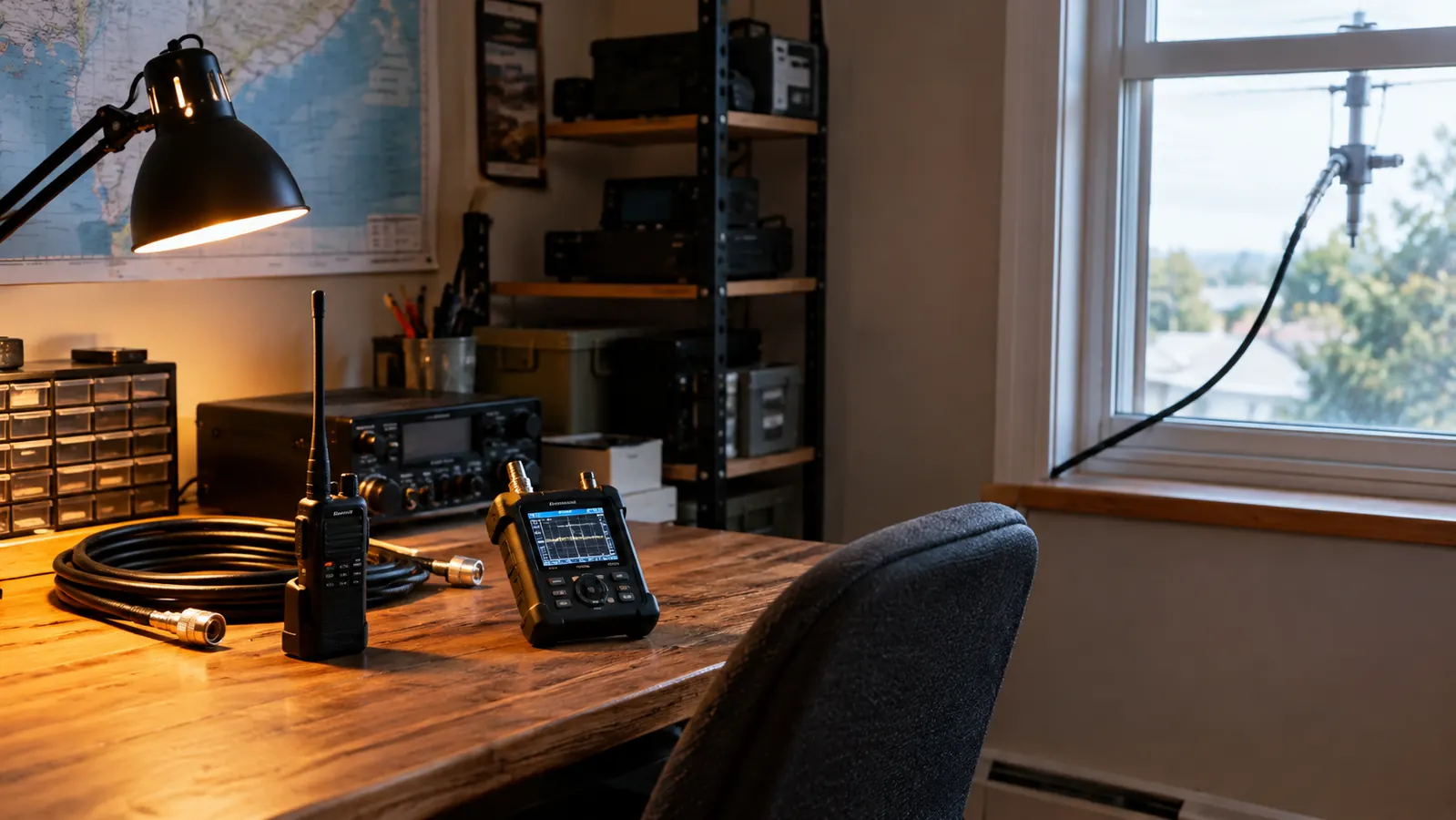
The first tool I bought when I rebuilt my setup two years ago was not a new radio. It was an analyzer: the AURSINC NanoVNA-H. That sounds backwards if you have never used one, but after more than fifteen years in this hobby, it is the piece of gear I would least want to give up. It is also the cheapest way I know to make every antenna you own work better.
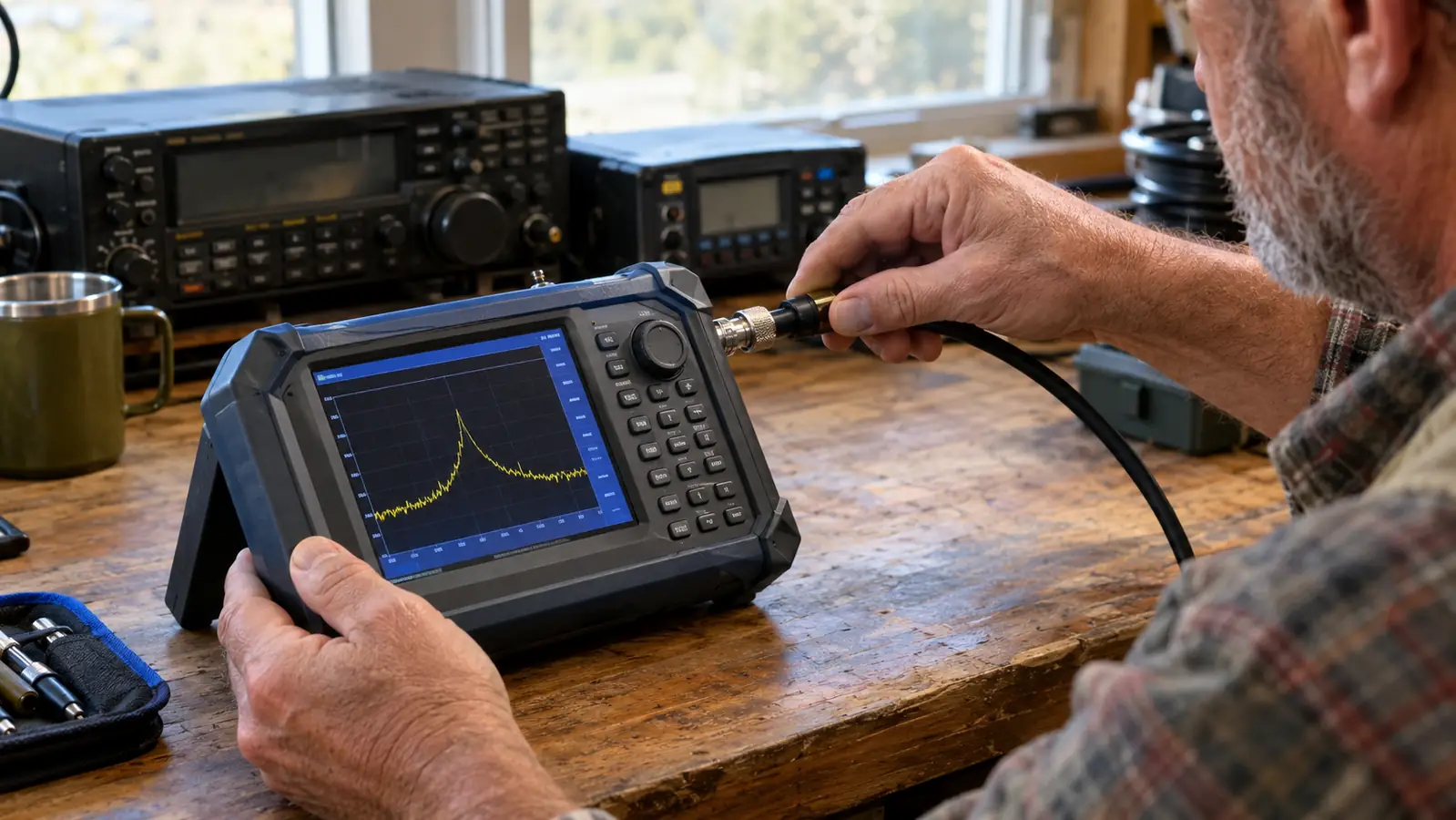
A vector network analyzer sounds like laboratory equipment, and it is. What it does for a ham is simple. It sweeps a range of frequencies and shows you how your antenna behaves across all of them at once. It gives you SWR, standing wave ratio, as a curve instead of a single number, so you can see how well the antenna and the coax feed line match your radio across the whole band. Once you have seen that curve, you will not want to tune an antenna blind again. I have held a General class license since 2012, and this little box still teaches me something just about every time I use it.
The analyzer I reach for before every antenna job
I have used the NanoVNA-H to check the backyard wire antenna, the VFAN magnet mount on the truck, and every piece of coax in between. It lives on the bench in the spare bedroom corner and goes out to the F-150 when I need it. AURSINC makes the version I own, and it has earned its spot.
Amazon Check Today's Price on Amazon →It catches a bad antenna before it cooks your radio
High SWR sends power back into the radio instead of out the antenna. A radio will tolerate some of that, but a badly mismatched antenna can damage the final amplifier, the stage that produces your transmit power, and that is an expensive repair. The analyzer shows you the problem before you ever key up, press the transmit button. I check every new antenna on the bench or on the truck before I put real power through it. That one habit has saved me more than the analyzer cost.
It turns antenna work from guesswork into measurement
The old way to tune a wire antenna was to cut a little, key up, check the meter, cut a little more, and hope. The analyzer way is to sweep the band and look at the curve. You can see the resonance dip, where the antenna is happiest, and you can see it move as you trim. You make one cut and sweep again. The guesswork is gone, and so is most of the cussing.
It checks the whole feed line, not just the antenna
A lot of antenna problems are not antenna problems at all. A PL-259 connector, the standard coax plug, that was not soldered well, coax that took on water, a shield that pulled loose from the connector: any of those will wreck your signal and none of them are visible from the ground. The analyzer sees the whole path from radio to antenna tip. When my signal goes soft, the first thing I do is sweep the feed line. It has found a bad connector I would have sworn was fine.
It shows you resonance, not just one number
A simple SWR meter gives you one reading at one frequency. The NanoVNA-H gives you the whole curve. You can see exactly where the antenna resonates, how wide the usable bandwidth is, and whether the dip is centered where you actually operate. On my backyard wire, the first sweep showed a dip almost a full megahertz below where the calculator said it should be. I never would have found that with a meter.
It finds problems before storms do
The 2020 ice storm that knocked out power and cell service in our county for four days is the reason I take this hobby seriously. Joan keeps a handheld on the kitchen counter during storm season, and I want to know the antenna feeding it is sound. After every bad storm now, I sweep the wire antenna before I need it, not after. Ice and wind shift trees and sag lines, and a line that sags can change your tuning. Ten minutes with the analyzer tells me whether the antenna still behaves the way it did last month.
It is small enough for the bench and the truck
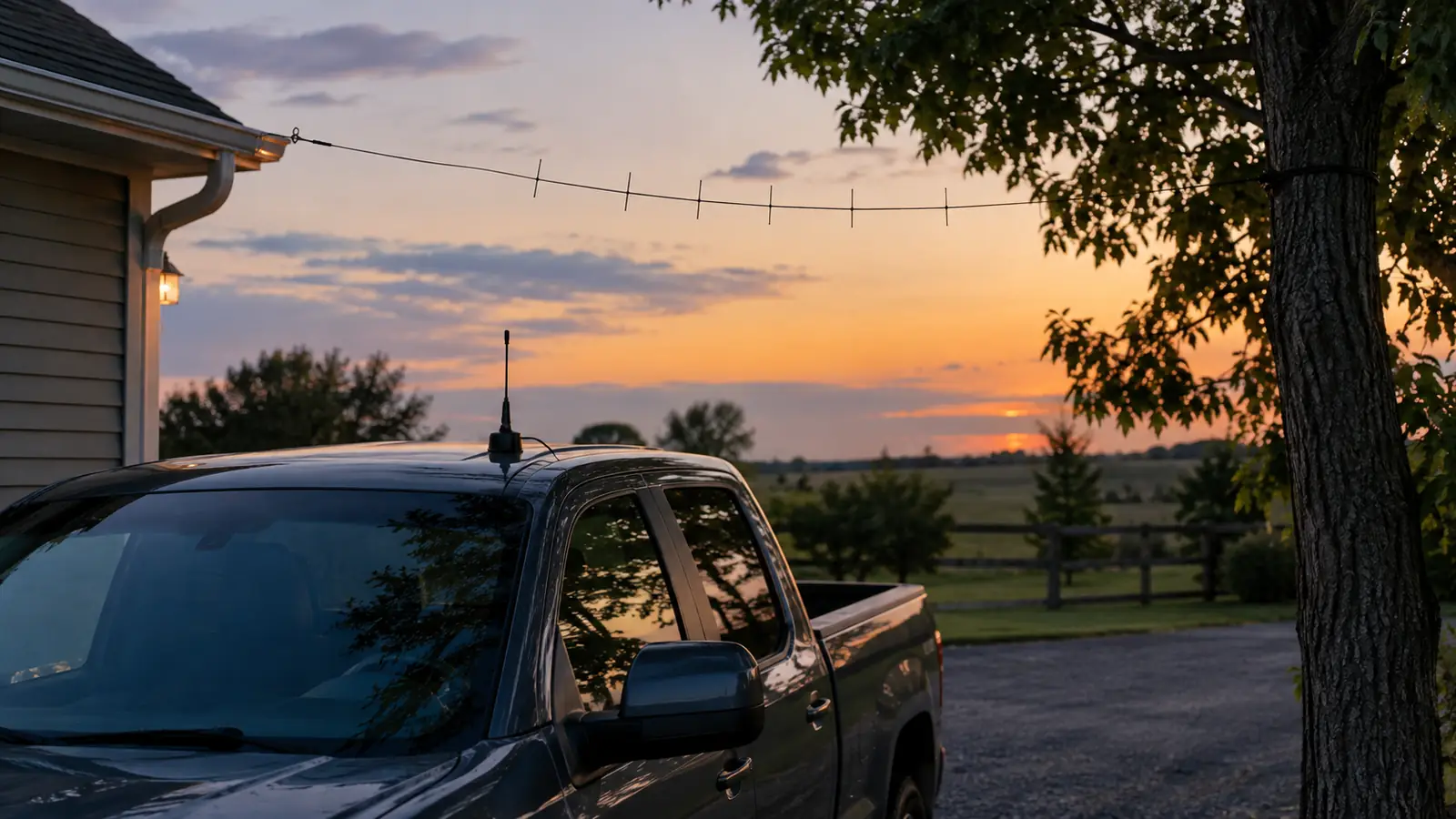
The analyzer runs on its own battery and fits in a coat pocket. It lives on the bench most of the year, but when I want to check the VFAN magnet mount on the F-150, I just carry it out to the truck. No power cord, no bench setup, no excuse. I have used it standing in the driveway with the truck door open more times than I can count.
It pays for itself the first time it saves a radio
I know hams who have burned out a radio because they trusted a cheap antenna and never checked it. A replacement radio costs real money. The analyzer costs a fraction of that, and it is the tool that keeps you from ever making that mistake. One saved radio, one avoided trip to the repair bench, one weekend not spent chasing a mystery problem. It does not take long to come out ahead.
It is the best antenna teacher I own
If you want to understand antennas, sweep a dummy load, a resistor that mimics an antenna, and sweep a real antenna and compare the curves. The dummy load shows a flat, boring line. The real antenna shows a dip where it resonates. That difference teaches more than any article I have read. I have walked newer hams through it at the bench, and it clicks every time.
It documents your setup over time
The analyzer can save traces, so you can compare how an antenna behaved in June and how it behaves in December, before and after a storm, before and after you moved a feed line. When something drifts, you can see it. That record has settled more than one argument with myself about whether a signal really got worse or I was imagining it. It is the closest thing this hobby has to a paper trail for your antennas.
It makes every other antenna you own better
The analyzer does not replace any of your radios. It makes all of them work better, because every radio is only as good as the antenna feeding it. The handheld on the kitchen counter, the mobile rig in the truck, the wire antenna out the window: I have swept all of them with this one AURSINC analyzer. It is the rare piece of gear that improves everything else you own.
What I'd Skip
Honestly, you can skip the NanoVNA-H if you only ever use a factory-tuned antenna that you never move, never trim, and never replace. If your idea of antenna work is screwing a store-bought dual band antenna, the kind that covers two meters and 70 centimeters, onto the roof and never touching it again, the analyzer will sit in a drawer. It also has a learning curve. The screen is small, the menus take some getting used to, and it is not a full service monitor, the bench instrument a shop uses to align radios. If you are not the kind of person who enjoys tinkering, this is not the tool that will change that.
The first sweep on my backyard wire showed a resonance dip almost a full megahertz below where the calculator said it should be. Twenty minutes of trimming fixed it. That is what the analyzer gives you: the truth about your antenna.
The one tool I would buy again tomorrow
If I had to start my setup over from scratch, the NanoVNA-H from AURSINC would be in the first order, ahead of half the radios I own. It is the tool I reach for before every antenna job, and it has paid for itself more than once.
Amazon Check Today's Price on Amazon →