
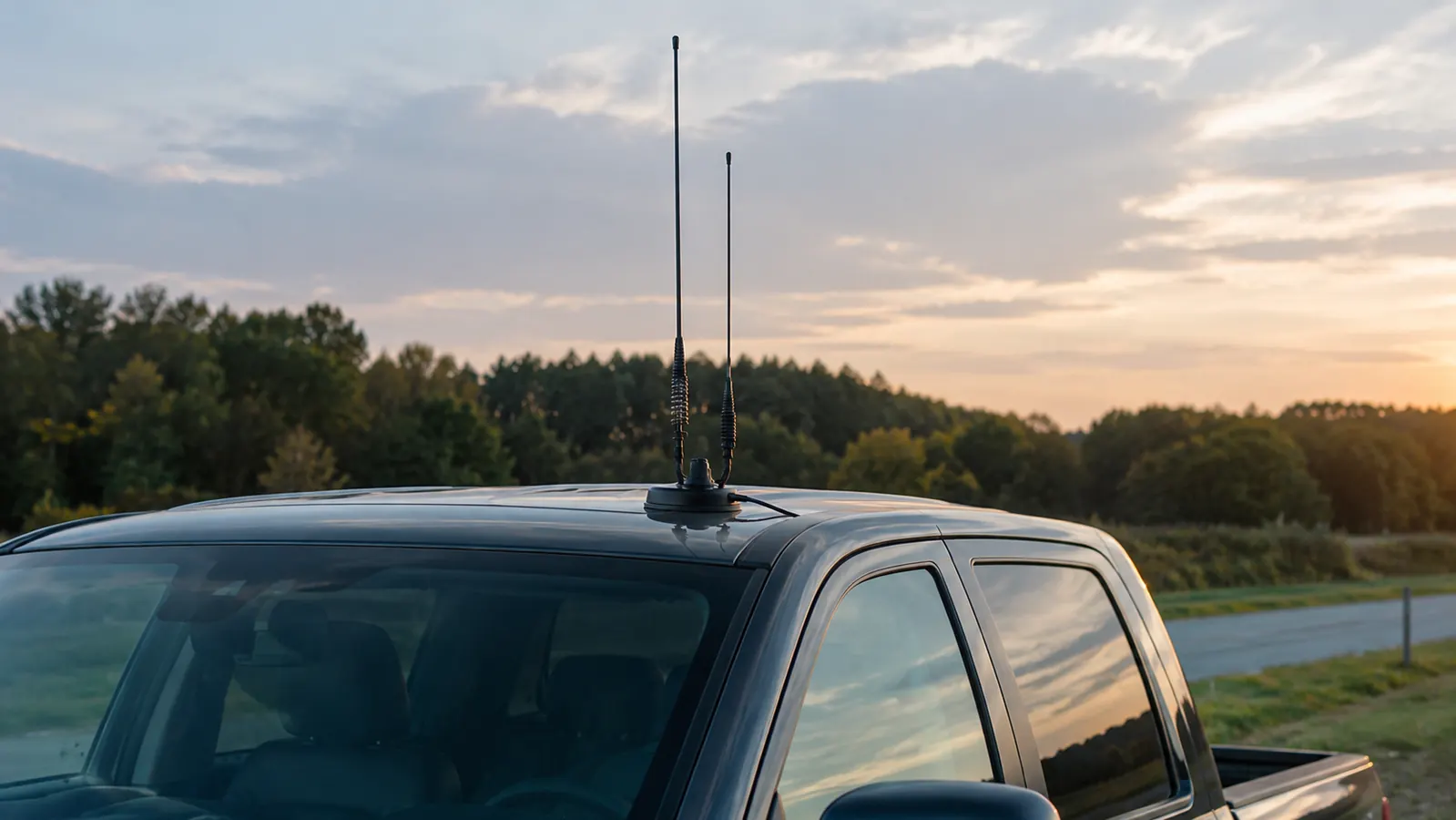
I bought the VFAN dual band magnetic mount antenna about two years ago, in the same stretch when I rebuilt my whole setup after my old handheld finally died. It sits on the roof of my F-150, feeds the AnyTone under the dash, and it has been through daily driving, a Tennessee summer, two ice seasons, and more repeater hunts than I can count. This is the long-term review I wish someone had written before I bought it.
If you are new to this, a magnetic mount antenna is exactly what it sounds like: a whip antenna on a base with strong magnets that holds it to the roof of your vehicle. No drilling, no hole in the metal, no permanent commitment. The VFAN covers 2 meters and 70 centimeters, which are the two bands most ham radio operators use for local and regional talking. You need a license to transmit, but you do not need one to listen.
The Quick Verdict
A tough, dependable dual band antenna that holds its tune and holds its ground. It will not win any beauty contests and the coax connection needs a periodic check, but after two years I have no reason to replace it.
Amazon Check Today's Price →Two years in, I would buy the VFAN again
It has survived daily driving, ice, and heat without losing its grip or its tuning. If you want a no-drill antenna that just works, this is the one on my truck.
Amazon Check Today's Price on Amazon →How I've Used It
The VFAN has lived on the cab roof of my older Ford F-150 since the second week of March, two years ago. I installed it the same afternoon the AnyTone arrived, ran the coax through the gap in the rear window seal, and checked the SWR with the NanoVNA-H before I keyed up for the first time. It took about twenty minutes, and I have not touched the mount since. During storm season I pull the AnyTone out of the truck and run it on the bench in the spare bedroom off the Tekpower supply, but the antenna stays on the truck. That is the point of a magnetic mount: it is always there when you need it.
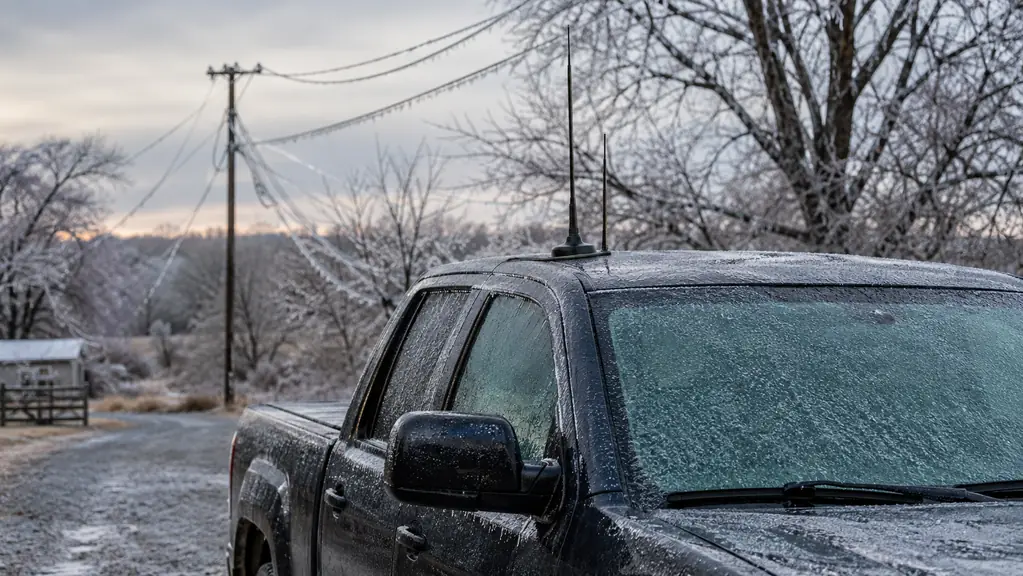
My county lost power and cell service for four days during the 2020 ice storm, and that is what got me serious about a setup that works off-grid. I remember standing in the driveway that first morning with the old handheld, getting nothing but static from the repeater on the ridge. That was the day I decided the next radio I bought would go in the truck. Joan keeps the Baofeng charged on the kitchen counter during storm season so she can reach me, but the truck is the reliable station. On the morning after the February freeze last year, the landline was down, the cell towers were quiet, and the 146.82 repeater was the only way I could tell her I was okay from the far end of the county. When the repeaters go quiet, I can still work simplex with the few neighbors who are also hams.
In two years I have put roughly 15,000 miles on the truck with this antenna on the roof. It has been through automatic car washes, highway speeds, gravel roads, and one very determined raccoon that decided to inspect it at 2 AM last fall. The magnet has never let go. The SWR, which I check with the NanoVNA-H every few months, has stayed flat since the first week, and I will get to the numbers in a minute.
I mostly run the VFAN on 2 meters because that is where the local nets live, but I keep 70 centimeters programmed in the AnyTone for the UHF machines and for the linked repeaters that cover the interstate corridor. On long drives I will switch to a distant repeater just to see how far the little antenna will reach from the cab roof. The honest answer is that a half-wave on a permanent NMO mount would hear more, but the VFAN has never left me unable to check in, and for a daily driver that is the test that matters.
What the VFAN Dual Band Magnetic Mount Antenna Actually Is
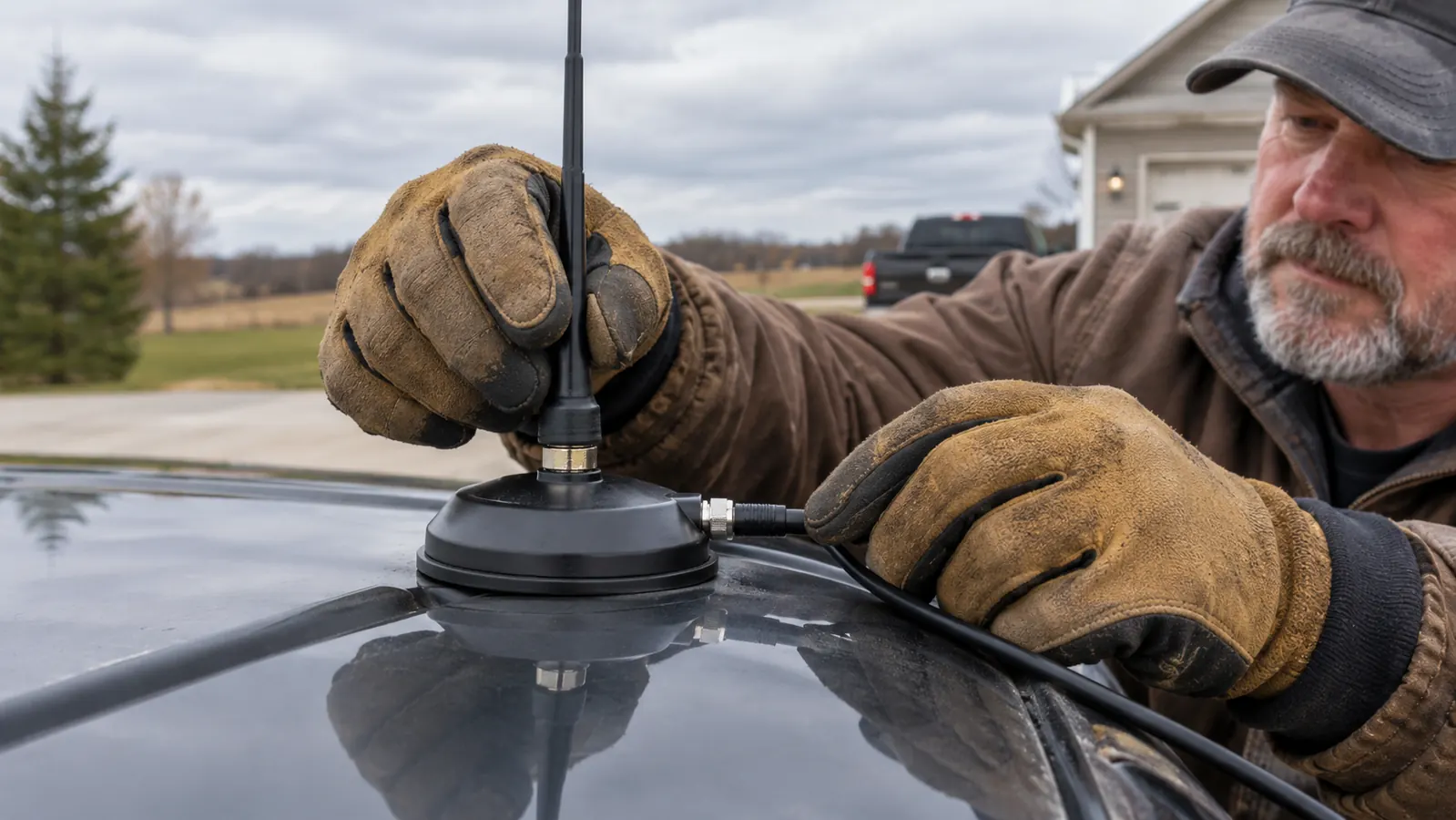
The VFAN is a dual band antenna, which means it is cut for 2 meters and 70 centimeters, the VHF and UHF ham bands. For most operators that covers local repeaters, simplex contacts, and the regional nets that matter in daily use. It is a quarter-wave design on 2 meters, which is the most forgiving length for a vehicle roof, and it does not need a ground plane kit because the metal roof is the ground plane. The 2 meter portion covers the 144 to 148 MHz range, and the 70 centimeter portion covers 430 to 450 MHz, which is the whole band plan a Technician or General will actually use. The whip is about the length of my forearm from elbow to fingertips, which puts the tip just above the cab roofline.
The base uses multiple small magnets rather than one big one, which is a design choice I have come to appreciate. A single large magnet can crack or lose strength if the base flexes. The cluster of smaller magnets spreads the pull and keeps the antenna planted even when the cable tugs at it. I have never had it shift position on its own, and I have never found it lying on the driveway. The base has a thin rubber boot on the bottom so it does not scratch the paint, and after two years of sitting in the same spot, the paint underneath still looks like the day I installed it.
The whip is a steel wire with a coating over it, which is normal for this class of antenna. It has some flex, which is what you want on a vehicle. A stiff whip will fatigue at the base and snap after a year of vibration. The VFAN bends when it needs to and springs back. The coating has held up against sun and road salt, which is more than I can say for the cheaper antenna I ran years ago. That one had a single big magnet and a stiff whip, and the whip snapped off at the base in a car wash about fourteen months in. That failure is why I checked the VFAN's flex before I even put it on the truck.
The coax is RG58 style, which is fine for the short run from the roof to the radio in a pickup. The connector on mine is a standard PL-259, and it screws into the AnyTone without an adapter. The run is about twelve feet with a little extra coiled under the dash so I can pull the radio out during storm season. If your radio uses a different connector, you will need a small adapter, and that is true of nearly every antenna in this class.
Performance Over Two Years
I tested the VFAN against the stock antenna that came with my old handheld, and the difference was immediate. From the driveway I could hit repeaters I had only been able to reach from the ridge behind the house. On 2 meters, the VFAN opened up the local machines with a clean signal report. On 70 centimeters, it was the same story: stronger into the repeater, clearer audio on the return. The first real confirmation came on a Tuesday night net a few weeks after install. Net control read my check-in back with a 5x9 on the first try, and I was sitting in the truck in the driveway, not up on the ridge.
The number that matters most to me is SWR, the standing wave ratio that tells you how much of your power is actually leaving the antenna instead of bouncing back into the radio. A high SWR can damage a solid state radio over time. I swept the VFAN with the NanoVNA-H when I first installed it and got 1.3:1 on 2 meters and 1.5:1 on 70 centimeters, both well under the 2:1 line where I start worrying. I ran the sweep twice to make sure I was not chasing a bad connection, and the trace looked the same both times. I checked it again at six months, at a year, and a few weeks ago. The readings had not moved by more than a tenth.
That stability is the real story of this antenna. Cheap antennas often drift as the connection corrodes or the whip fatigues. The VFAN has held its tune through two full seasons of weather. I run it into the AnyTone at full power on both bands and I have never seen the radio complain, which tells me the antenna is doing its job. On the simplex side, I have made a handful of contacts that surprised me. The best one was a neighbor eleven miles away, both of us mobile, both running mag mounts, and we held a conversation for the whole drive home from town. Neither of us was running more than 25 watts.
One more data point: last summer I took the VFAN off the truck and set it on a cookie sheet on the bench in the spare bedroom, just to see if the mount would hold when the radio was inside. It did, and it let me hit the same repeaters from the house that I normally reach from the truck. I do not recommend running a mag mount indoors as a permanent answer, but it is a useful way to test a radio without dragging the truck into the yard.
The SWR reading has not drifted in two years. That is the whole review in one sentence.
What Annoyed Me
No antenna is perfect, and the VFAN has three things that bug me. First, the coax connection at the base needs a periodic check. The set screw works loose after a few months of vibration, and when it does, the SWR creeps up. I caught it last fall because a routine sweep showed 2.4:1 on 2 meters, which is high enough to worry me. The first time it happened I was on the road, and I only caught it because the receive audio started sounding dull. A quick stop, a quarter turn on the screw, and the reading came right back down. It is a five minute fix with a screwdriver, but it is a real maintenance item, not a set it and forget it deal. I now tighten that screw every time I change the oil, and the reading has stayed put.
Second, the whip is long enough that it brushes low branches on my gravel driveway. I have learned to listen for the sound of leaves hitting the roof. It has never damaged the antenna or the truck, but it is a noise you will notice if you park under a tree. The same length that makes the antenna work well is the same length that reaches into the oak limbs over the driveway, so you take the good with the good.
Third, the magnetic base can pick up loose metal debris. I park in a gravel drive and work in a shop with metal shavings on the floor, and I have had to clean small bits of steel off the base a few times. The worst was a handful of number six sheet metal screws that came off the bench when I set the base down to tighten the connector. It does not affect performance, but it is worth knowing before you set the antenna down on a workbench.
What I Liked
- Strong magnetic hold that has never let go in two years
- Stable SWR across both bands, verified with the NanoVNA-H
- No drilling required, easy to move between vehicles
- Dual band coverage for 2 meters and 70 centimeters
- Coating and whip have held up against sun and road salt
Where It Falls Short
- Coax set screw at the base works loose and needs periodic tightening
- Whip is long enough to brush low branches
- Magnetic base picks up loose metal debris
- Not a tall performer; it is a solid entry level antenna, not a contest antenna
Who This Is For
The VFAN dual band magnetic mount antenna is for the ham who wants a dependable mobile setup without drilling holes in a vehicle. It is for the new Technician who just got licensed and wants to hit the local repeaters from the car. It is for the General who wants a spare antenna that can move between vehicles in ten minutes. It is for anyone who remembers what it is like to be stuck with a rubber duck antenna and a weak signal.
If you are building your first mobile station, this is the antenna I would start with. It is forgiving, it is inexpensive enough that it does not hurt when you upgrade, and it will teach you what a real ground plane does for your signal. The mount does not care which truck it is on, which means you can move it to a rental or a borrowed vehicle for a weekend trip and have a real antenna instead of a rubber duck. Pair it with a decent dual band mobile radio and you will be surprised what you can hit from the road. That is the exact path I took, and two years later the only thing I have changed is the radio.
Who Should Skip It
Skip the VFAN if you need a permanent installation. If you are willing to drill a hole and run a proper NMO mount, you will get a better connection and one less thing to check. Skip it if you do most of your driving under dense tree cover, where the long whip will be a constant noise. Skip it if you are chasing weak signals on a regular basis, because a taller antenna on a permanent mount will hear more.
And if you are the kind of operator who will never check a connection or clean a magnet, this antenna will eventually annoy you. It is not high maintenance, but it is not zero maintenance. The set screw will work loose, and when it does, your SWR will tell you. That is not a flaw in the antenna. That is the tradeoff of a mount you can remove in ten seconds, and I think it is a fair one.
The antenna that has earned its spot on my truck
Two years in, the VFAN is still the first thing I recommend to a new ham setting up a mobile station. It holds, it tunes, and it keeps working.
Amazon Check Today's Price on Amazon →