
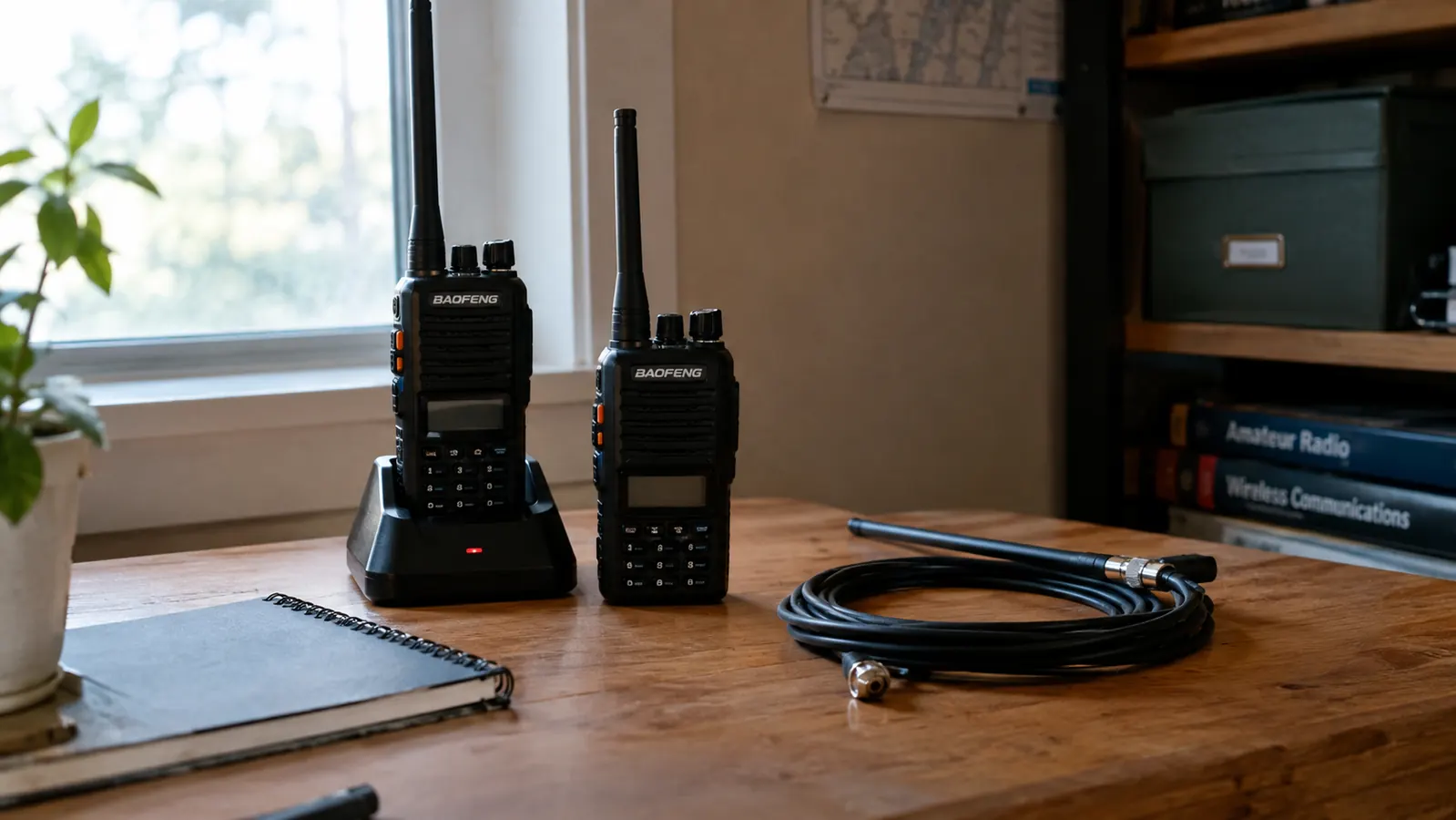
You passed your test, got your license, and now you are staring at the same two radios every new ham stares at. The Baofeng BF-F8HP is the little dual-band handheld, covering both the 2-meter and 70-centimeter bands, that shows up in every storm-prep video on the internet. The Yaesu FT-65 is the one the old-timers tell you to buy because it will still be working when your truck is in the junkyard. I have owned both for about two years. I have used both on daily drives, on repeater nets, and through a four-day outage when the county went dark. Here is what the price difference actually buys you, and what it does not.
Short answer: if you are a new ham, or you want a radio to sit charged on the kitchen counter for storm season, buy the Baofeng BF-F8HP and spend what you saved on a better antenna. If you want one handheld that will still be going in ten years, and you are willing to pay for it, buy the Yaesu FT-65. Neither choice is wrong. The mistake is buying either one without knowing what you are giving up.
How I Compared Them
I ran both radios side by side for two years, not in a lab. I checked the SWR on the antennas I use, which is a measure of how well the antenna is matched to the radio, and tuned them with my NanoVNA-H before I started. Then I just lived with the radios. I carried the Baofeng on my belt, left it on the kitchen counter for Joan during storm season, and used the Yaesu in the radio room and on the road. I talked on repeaters, listened for weak signals on quiet nights, and dropped both radios on the gravel at least once. The results were not close in some ways and surprisingly close in others.
I tested them the way a ham actually uses a handheld. I started by checking the SWR on both antennas with my NanoVNA-H, trimming the backyard wire antenna to 1.4:1 on 2 meters and the truck antenna to 1.5:1 before I did any serious listening. Then I programmed both radios with the same repeater list, including the machine on the water tower sixteen miles south of the house, and set the CTCSS tones the same way on both. I carried each radio for a week at a time, listened from the same spot in the yard at the same times of day, and kept a notepad log of every net I checked into and which radio was in my hand. I also left the Baofeng on the kitchen counter for Joan during storm season, the way we do in this house, and I took the Yaesu out to the truck and up the road. That is not a lab test. It is a real life test, and I trust it more.
| Baofeng BF-F8HP | Yaesu FT-65 | |
|---|---|---|
| Price | Costs a fraction of the Yaesu; the savings buy a spare battery, a programming cable, and a better antenna | Costs several times as much; you are paying for the name, the build, and the warranty |
| Transmit power | 8 watts on both bands, enough to reach one more repeater on a good day | 5 watts, the standard for a handheld, and honest about it |
| Build quality | Dense plastic that creaks when you squeeze it; fine for the counter, a gamble on gravel | Gasketed and solid, like it was machined instead of molded |
| Receiver | Hears the local repeater fine; misses weak signals on a quiet night | Better front-end filtering; pulls in weak signals the Baofeng walks past |
| Programming | You will want a cable and CHIRP; the menu is a maze until you learn it | A more logical menu, and Yaesu's software works with the same cable |
| Battery | Cheap, everywhere, and easy to keep two spares in a drawer | Reliable and sealed, but replacements cost more |
| Accessories | Speaker mics, headsets, drop-in chargers, all cheap and easy to find | Fewer options, and the ones that exist cost more |
| Warranty and support | Thin on paper; the community is your real support | A real warranty and authorized service centers |
| Best for | New hams, loaner radios, storm boxes, anything that might get dropped in a ditch | Someone who wants one handheld to last a decade |
Where the Baofeng Wins
Start with price, because that is the whole argument for the Baofeng. The BF-F8HP costs a fraction of what the Yaesu costs, and the savings are real money. For what you save, you can buy a programming cable, a spare battery, a speaker mic, and a better antenna, and you still come out ahead. That is not a small thing. A handheld with a good antenna on it will outperform an expensive handheld with a bad antenna every single time. The BF-F8HP is the third generation of the UV-5R, the radio that made Baofeng famous, and it has more than fifteen thousand reviews on Amazon with a four-and-a-half-star average. That many hams are not all wrong. I put the savings toward a better antenna for the radio room, and that one purchase did more for my signal than any radio upgrade ever has.
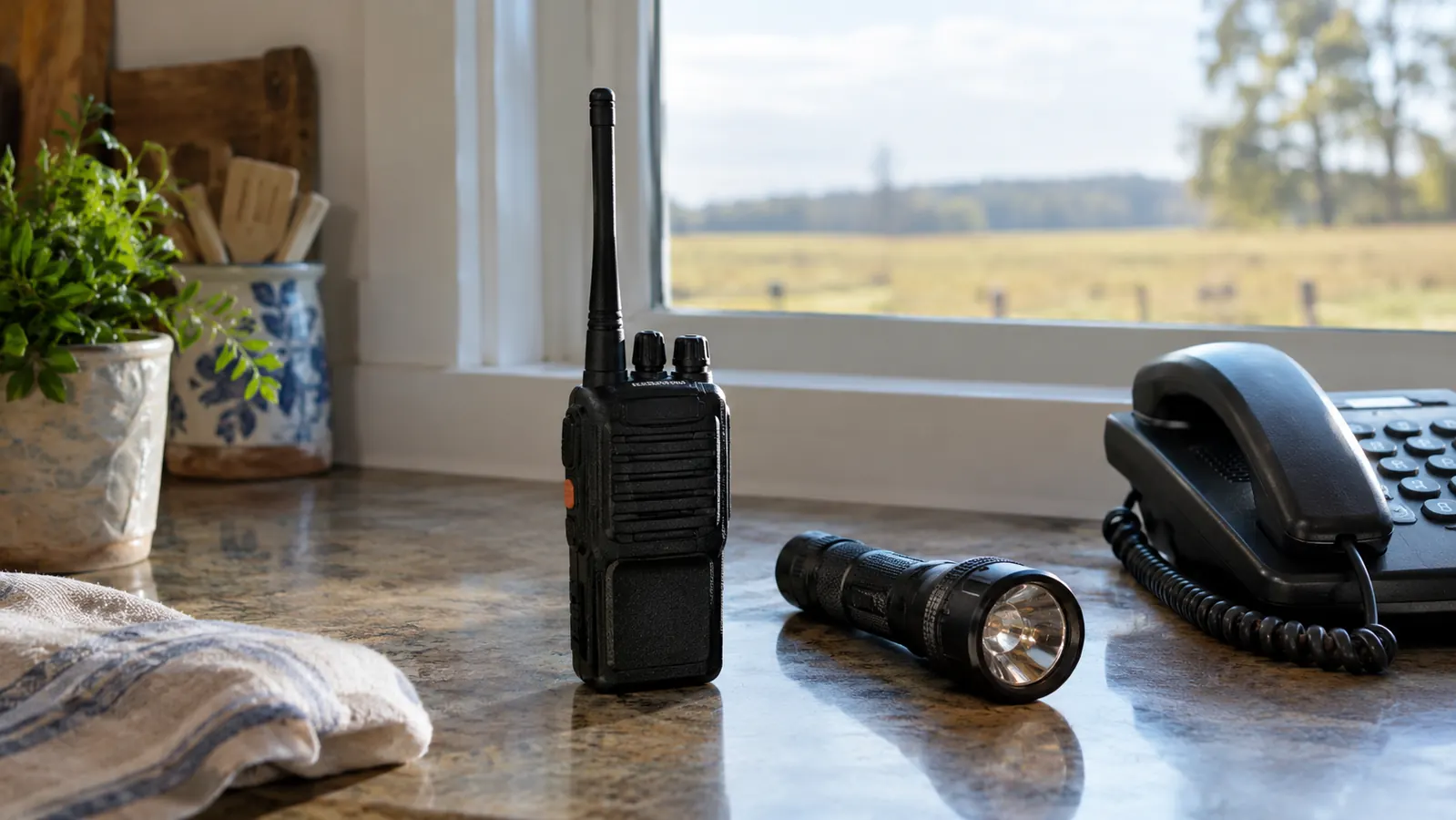
The Baofeng also puts out 8 watts on both bands, where the Yaesu puts out 5. On a handheld, that extra power is worth maybe one more repeater on a good day, not a night-and-day difference, but sometimes one more repeater is the difference between making the net and missing it. The battery situation is the other big win. Baofeng batteries are cheap and everywhere, so I keep two spares in a drawer. When the ice storm hit our county in 2020 and the power and cell service went out for four days, a charged handheld with a spare battery in the drawer was worth more than any feature list. Last February a windstorm took the power out for two nights, and Joan grabbed the BF-F8HP off the counter and called me out at the shed. During storm season it sits charged on the kitchen counter so she can reach me if the power goes out. It has never failed that job.
Where the Yaesu Wins
Build quality is where the Yaesu FT-65 earns its keep. The Baofeng is dense plastic that creaks when you squeeze it. The Yaesu feels like a tool, gasketed and solid, like it was machined instead of molded. I dropped both on the gravel at the end of the driveway. The Baofeng survived, which surprised me. The Yaesu survived, which did not. If you are the kind of person who buys one good tool and expects it to outlast you, that difference is worth the money by itself.
The receiver is the other place the Yaesu pulls ahead, and it is the one that matters most on a quiet night. One night last October I sat in the radio room with the window cracked and listened to a net check-in from a mobile rig west of the county line. The Yaesu pulled it in clear enough to copy. The Baofeng, sitting on the bench beside it, heard nothing but noise. That is the difference in one story. The Baofeng hears the local repeater fine, and it will not fail you on a net. But the Yaesu hears more, and in ham radio, hearing more is the whole game. The front-panel menu is also laid out like a person designed it, which is more than I can say for the Baofeng. You will still want a programming cable for either radio, but the Yaesu is easier to live with day to day. Yaesu also backs the FT-65 with a real warranty and authorized service centers. With the Baofeng, you are the warranty.
The Baofeng is the pick if you want the most radio for the least money.
Two years in, my BF-F8HP still sits charged on the kitchen counter every storm season, and it has never let me down. Check today's price on Amazon and see if it fits your budget.
Amazon Check Today's Price on Amazon →The Programming Question
Both radios need a programming cable and software before you will love them. I use CHIRP, which is free and works with both, and I set the CTCSS tones, the sub-audible tone codes that keep a repeater from squelching on you, the same way on both radios. I tried programming the Baofeng by hand first, following the manual, and gave up after twenty minutes of scrolling through menus. Then I bought a programming cable, loaded CHIRP, and had the whole repeater list in the radio in five minutes. The Yaesu's menu is better, but not so much better that it changes my recommendation. If you are willing to spend one evening with a cable and a laptop, the Baofeng is completely workable. If you refuse to plug a radio into a computer, buy the Yaesu.
What the Specs Don't Tell You
The spec sheet will not tell you how a radio feels in your hand after an hour of talking on a net. The Baofeng is lighter and a little cheaper feeling, and the knobs are stiffer. The Yaesu is heavier, which sounds like a downside until you realize the weight is the build quality. The spec sheet also will not tell you that the Baofeng's speaker gets muddy at high volume, or that the Yaesu's stays clean. Neither one will win an audio contest. Both are perfectly usable. One more thing: the Baofeng's controls stiffen up when the temperature drops below freezing, and the Yaesu does not seem to care. It is a small thing, but in February it is the thing you notice.
The spec sheet will tell you the Baofeng puts out 8 watts and the Yaesu puts out 5, and that is true. What it will not tell you is that the Baofeng's battery drains a little faster at that higher power, so the extra wattage costs you talk time. On a full charge I get about eight hours of light use out of the Baofeng and closer to ten out of the Yaesu. It will not tell you that the Yaesu's battery meter is more honest, or that the Baofeng's meter sits at full for an hour and then drops like a stone. These are the things you learn in the second year of ownership, and they matter more than the brochure numbers.
Who Should Buy Which
If you are a new ham, buy the Baofeng BF-F8HP. You need a license to transmit, and you need to learn how to program a radio, and you need to find out what you actually use a handheld for. The BF-F8HP lets you do all of that for very little money, and when you outgrow it, it becomes the best loaner radio you own. I have handed mine to visiting hams who forgot their gear, and it has been dropped, rained on, and left in the truck overnight. It keeps working.
If you are the kind of person who buys one good tool and keeps it for twenty years, buy the Yaesu FT-65. It is the better built radio, it hears more, and it will still be working long after the Baofeng has worn out its second battery. I own both, and I would not own two Yaesus or two Baofengs. The Baofeng sits on the kitchen counter during storm season, and it rides in the truck when I do not want to risk the good radio. The Yaesu lives in the radio room and goes on the longer hikes. If you can only buy one, buy the one that matches how you treat your gear.
If You Are Buying for Storm Season
If you are setting up a radio for storm season, the Baofeng is the easy choice. It is cheap enough to sit on the kitchen counter for months, and the battery holds a charge. I check mine every few months and top it off when the forecast turns. I also keep a spare battery in the drawer next to the flashlight and replace it every couple of years whether it needs it or not. The Yaesu is also a fine storm radio, but I would rather keep the Baofeng on the counter where Joan can grab it and keep the Yaesu in the radio room where I use it every day. When the power goes out, the radio that is charged and ready beats the radio that is perfect and sitting on a shelf.
The Bottom Line
I have recommended the Baofeng BF-F8HP to more new hams than I can count, and I have never had one come back and say it was a mistake. I have also watched hams who bought the Yaesu FT-65 first and never looked back. The BF-F8HP is the better value. The FT-65 is the better radio. If you want my honest advice, buy the Baofeng first, learn it, and if you find yourself reaching for it every day, upgrade later. The Baofeng will still be useful the day you upgrade, and that is the highest compliment I can pay a piece of gear. If you want the full story on the BF-F8HP by itself, there is a longer review on this site that covers two years of daily use.
Start with the Baofeng and never look back.
You need a license to transmit, and you need to learn the radio either way. The BF-F8HP gets you on the air today, and if you outgrow it, it becomes the best loaner radio you own. Check today's price on Amazon.
Amazon Check Today's Price on Amazon →